
The question of how to get more Google reviews is less about customer satisfaction than you might think.
A 2025 study asked people what stopped them from leaving online reviews.
The most common reason was that their experience wasn’t noteworthy. (1)
But this still made up just 24% of responses. What went wrong with the remaining three quarters?
The other answers are actually quite reassuring, especially for businesses with little time or money to invest in getting more Google reviews. Even small, local businesses have the power to remove most of the barriers.
This guide to increasing Google reviews shows how. To jump ahead, click one of the topics below.
- Why people don’t leave Google reviews
- How to get more Google reviews
- What to do after getting more reviews
- What not to do (Google’s rules matter)
- FAQs about Google reviews
One quick note before we get started: if you haven’t filled out your Google Business Profile, we recommend doing so before reading any further.
This should take roughly 15 minutes. To find out why it’s so important, and for more quick tips and tactics, see our guide to local marketing.
Why people don’t leave more Google reviews
The good news is that people are over twice as likely to leave positive reviews as negative ones. The bad news is 31% of people didn’t leave any reviews at all last year. (2)
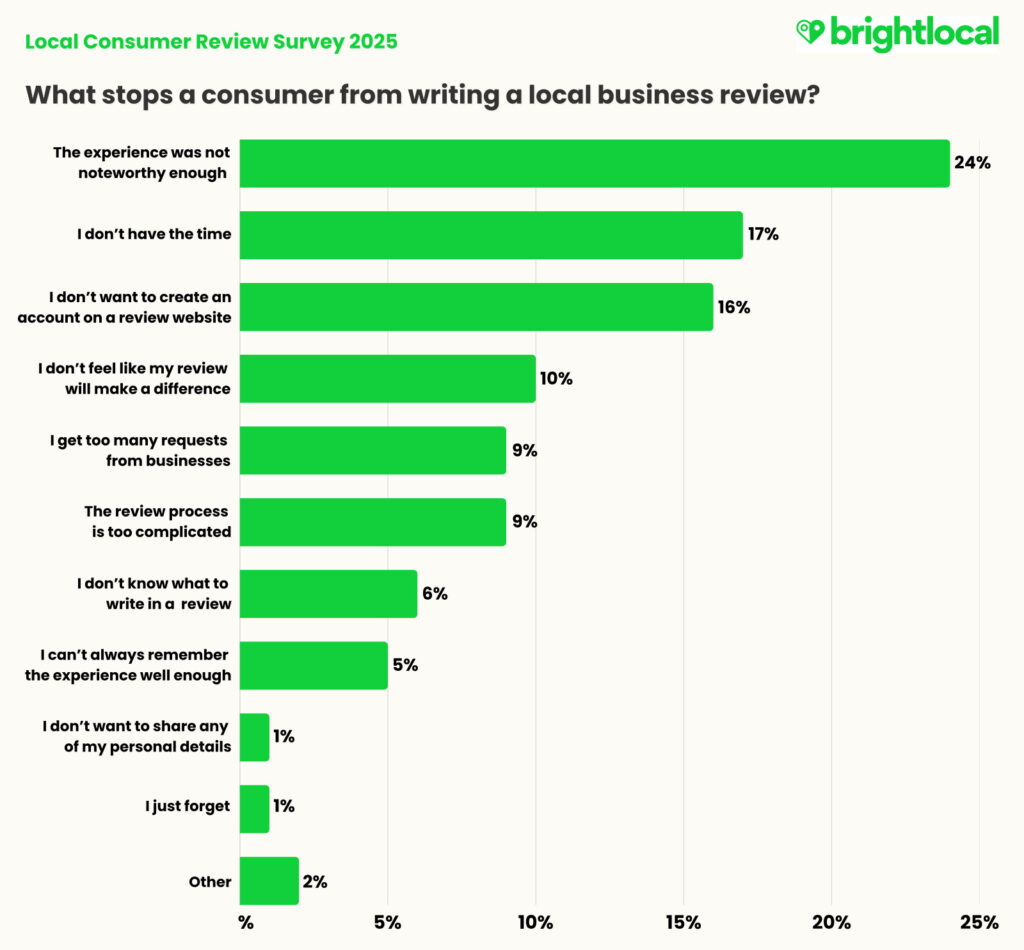
As mentioned before, the most common reason for not leaving a review is the experience itself.
But there are simple fixes for nearly everything else on this list.
How to get more Google reviews
Make leaving Google reviews easier
Together, these three barriers stop 42% of would-be reviewers:
- I don’t have the time (17%)
- I don’t want to create an account on a review website (16%)
- The review process is too complicated (9%)
There’s one thing you can do that, for many customers, will remove all of them: send a direct review link.
The link takes them straight to the Google review form. This saves time, effort and, for anyone with a Google account, there’s also no extra sign-up.
Here’s how to create this link:
- Sign in to your Google Business Profile
- Click “Ask for reviews”
- Copy the short link Google generates
- Share it with customers directly via email or message
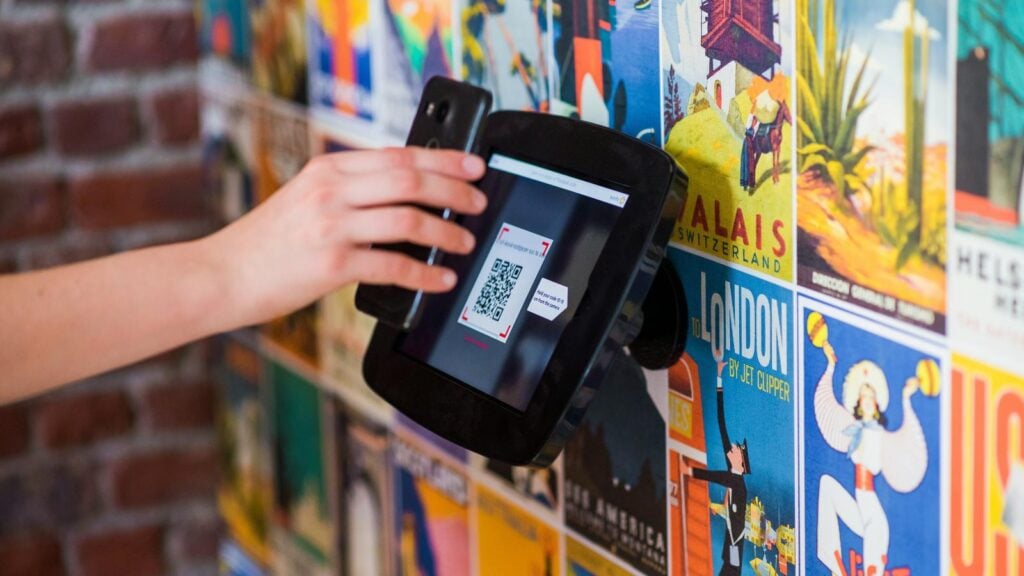
You can also download and print the link as a QR code for customers to scan at your place of business. This way, you can ask for a review in person and your customer can do it on the spot.
Tell your customers how much reviews matter
Asking in person can also fix two other things that stop customers from leaving reviews:
- I get too many requests from businesses (9%)
- I don’t feel like my review will make a difference (10%)
A request from a real person is harder to ignore than one of the automated emails from businesses we all get.
It also gives you a moment to explain why you’re asking. For example, by saying:
“Reviews are how businesses like ours get found. But most people don’t realise how important they are.”
Asking for a review might seem like annoyingly basic advice. But you might be surprised by how effective it can be.
BrightLocal’s 2026 survey found 83% of people who were asked to leave a review went on to do so. (2)
Jog their memory with a personal message
The next two reasons have to do with the actual work of putting thoughts into words:
- I don’t know what to write in a review (6%)
- I can’t always remember the experience well enough (5%)
You can solve both problems by doing the remembering for them.
Whenever possible, make a habit of jotting down notes on customer exchanges. They’re gold when it’s time to follow up with a personal message asking for online feedback.
Here’s an example for a business that runs kids’ classes:
“Hi Sarah, it was so lovely having Theo in class today. He was a star during the dance routine. If you have a minute, a Google review would mean the world.”
Just one detail can either jog a customer’s memory or give them something to copy into their review.
And even if they don’t end up writing a review, showing you remember them builds goodwill. This in itself is good for your business.
Research suggests ’emotionally connected’ customers are more than twice as valuable as merely ‘satisfied’ ones. (3)
Little personal touches like the above are how you build those connections.
📨 Get one quick local marketing tip in your inbox every week
Loopla writes a free weekly newsletter built for people who run kids’ classes, camps and clubs around London. Each issue gives you one practical idea you can try that week.
👉 Sign up for weekly local marketing ideas
What to do after getting more reviews
What you do with online reviews matters, too.
80% of consumers are more likely to use a business that responds to every review. (2)
In the case of negative reviews, this is a chance to show you care about service. Just remember to avoid the temptation to become defensive. It’s best to stay calm, acknowledge the issue and suggest continuing the conversation through another channel.
If you struggle to find the words or the time, AI tools can draft a response in seconds. Just be sure to read it back and edit it in your own voice, as replies that read like AI put off half of customers. (1)
Another way to make use of your best reviews is to post them anywhere you can. You can use screenshots for Instagram stories, for example. This makes for effective promotion because, as we’ll come onto shortly, new customers trust other customers more than your marketing.
What not to do (Google’s rules matter)
Google has cracked down on fake and incentivised reviews in recent years. So it’s worth reminding yourself of their review policies.
These policies prohibit:
- Offering incentives to customers: Discounts, freebies and prize draws, for example.
- Review gating: This means only asking your happy customers or screening reviews with a private survey first.
- Bulk solicitation at one event: Google can flag clusters of reviews from one location or device as suspicious.
- Posting reviews yourself: Or asking staff, friends, or family to do so.
Penalties start with reviews being removed. In more serious cases, Google can suspend your Business Profile and display a public warning banner on it. (4) This would mean every potential customer searching for you sees a notice that contributions to your profile have been paused.
One useful clarification: you can’t reward customers for reviews, but you can reward your own staff for collecting them.
Why asking for Google reviews is worth your time
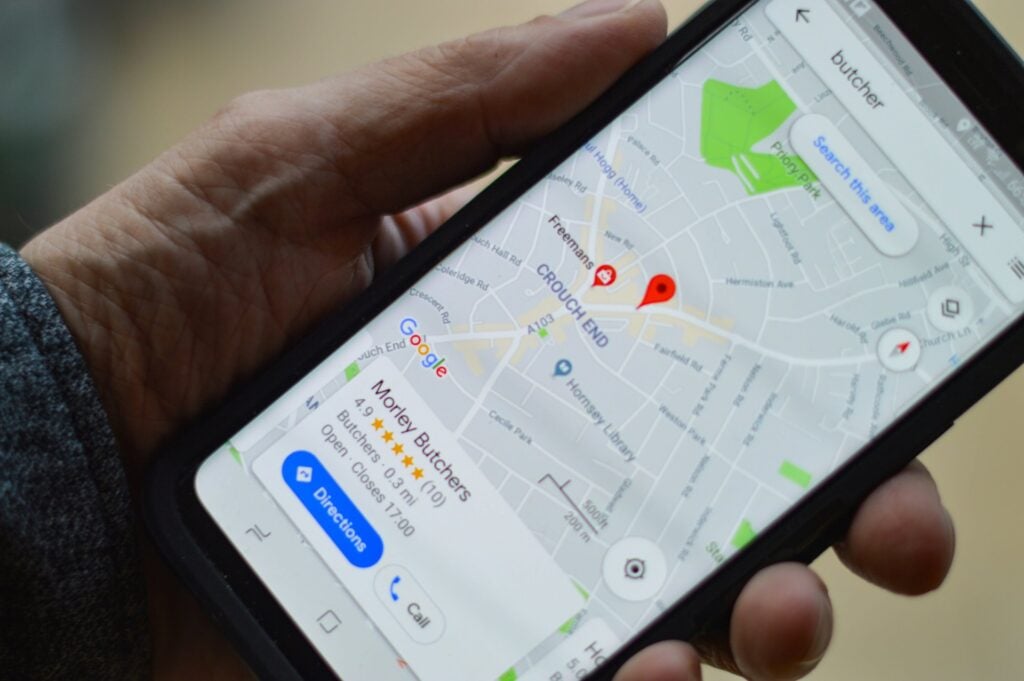
These days, online reviews are more effective than adverts.
Part of the reason is that people find online reviews more convincing. One study found 54% of consumers trust online reviews more than recommendations from family, marketing, the media or influencers. (5)
And unlike most kinds of advertising, customers actively seek reviews. Only 4% of customers say they never read them before using a business. (1)
So if your business doesn’t have enough reviews, you risk being overlooked, or worse. Because a lack of reviews also leaves you more vulnerable to the impact of bad ones.
According to a 2025 study, the average business has around 39 Google reviews. (6)
For one that averages 4.5 stars on Google, a single 1-star rating would pull them down to 4.4. To recover, they would need 9 new 5-star reviews.
This matters more than ever in 2026. 31% of customers now only use businesses rated 4.5 stars or above, up from 17% last year. (2)
Want more quick marketing tips?
If you’d like ideas like these delivered to your inbox each week, sign up for our free newsletter.
It’s built for people who run kids’ classes, camps and clubs in London. However, many issues contain quick, practical tips that most local businesses can try or adapt.
Sign up below 👇
FAQs: How to get more Google reviews
How many Google reviews do I need?
Most customers want to see at least 20 reviews before they use a business. (1)
Just under half of customers won’t use a business with fewer than 20 reviews. Only 9% will use a business with five reviews or fewer.
How high should my average Google review rating be?
You should aim for an average Google review rating of 4.5 stars or higher.
In 2026, 31% of customers will only use businesses with this rating or higher. (2)
This figure is up from 17% in 2025, suggesting customer expectations are higher when it comes to Google reviews.
68% of customers will only use a business with 4 stars or more.
Where should I tell people to review my business?
Tell people to review your business on Google by default.
Google’s share of online reviews fell in 2026, with more customers using sites like Facebook or AI tools. (2) But if you only have time to focus on one, it should be Google. 71% of customers still use it.
Most consumers will look at more than one review platform before using a business, though. (1) So if you’re happy with the number of fresh reviews you have on Google, you might consider temporarily sending people to other sites like Facebook or Trustpilot.
References
1. Local Consumer Review Survey 2025, BrightLocal
2. Local Consumer Review Survey 2026, BrightLocal
3. An Emotional Connection Matters More than Customer Satisfaction, Harvard Business Review
4. New ways we’re protecting businesses on Maps, Google
5. Influence of Online Reviews on Consumer Decision-Making, Reputation
6. Average Google Rating: 2025 Report, Voted Number One